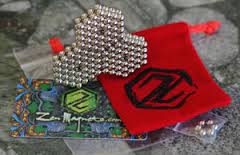
 In my Toys for Torts post, I covered the Consumer Product Safety Commission’s fight to force a recall of magnetballs. These toys (or should I say “science kits?”) have become the modern lawn dart. Federal regulators say the product poses an inherent danger to children and animals. Magnetball sellers say the dangers are exaggerated and warning labels should suffice.
Two of the largest magnetball companies were named Buckyballs and Zen Magnets. Each sold millions of magnetballs into the U.S. market, starting around 2009. The companies had some friction in 2011 when Buckyballs CEO threatened to sue Zen Magnets and got this YouTube video in return. But regulatory enforcement makes strange bedfellows, and the intra-industry tiff took a back seat in 2012 when the CPSC sued both companies, trying to force a recall.
The companies had different reactions to the lawsuit. Buckyballs CEO Craig Zucker fought the lawsuit in the press and with lobbying efforts in Washington, but eventually shut down the LLC that was selling the product. The CPSC responded by amending its lawsuit to add Zucker as an individual defendant. Zen Magnets, on the other hand, continued business as usual. It still offers magnetballs for sale through its website.
Just last month, Zucker and the CPSC signed a consent order. Zucker, with no admission of wrongdoing, pledged $375,000 toward a recall of Buckyballs. Here is the consent order. It looks like Zucker will need to put up $100k towards publication of a website, to last five years, and administration of a six-month recall, with the rest of the money put in escrow to pay claims. However, if there are any unclaimed funds left in the escrow after one year, Zucker gets the money back. (It’s not clear to me what would happen if there were more recalls in one year than could be supported by the escrow account. Do the U.S. taxpayers foot the bill?)
Both sides claimed victory – Zucker (or an anonymous supporter) through a WSJ opinion piece, and the CPSC Commissioners through their website. However, each Commissioner had a different reaction. Robinson’s press release crows almost as loudly as Zucker’s. Buerkle supports the settlement, but takes offense at the fact that Zucker was added as a defendant by unilateral action of the Presiding Officer, and not by a vote of the Commission. Only Adler, who dissented from the settlement, says it didn’t go far enough. He makes two points that were in my mind upon reading the consent order – why pay to maintain a recall website for five years if customers only have six months to respond? And is $375k enough?
The second point is significant in deciding who really won this battle. Did Zucker beat City Hall? Or did he end up doing basically what the CPSC wanted in the first place? Let’s do a little back-of-the-napkin math. In its Complaint, the CPSC estimated 2.5 million Buckyballs (or variants) were sold. A set of 10 cost $3.50. 250k sets at $3.50 each gives us $875k. Now, Zucker himself has been quoted as saying he made millions off Buckyballs, so we might assume the $875k number is low. But how many purchasers are likely to actually return their Buckyballs? Presumably anyone who finds the product dangerous already got rid of it. The $275k in escrow covers the return of about 78,000 sets. Of course there is postage, etc., but I have a hard time believing Zucker would have experienced this level of returns even if he agreed to a recall at the outset (and he might have saved some hefty litigation fees).
What effect will this consent order have on future market behavior? Does a penalty of this size have a deterrent effect? I doubt it, but the CPSC’s willingness to hold LLC members personally liable might. Or the maneuver may simply have made Zucker a hero to small gov advocates, with a strong base of support for his future projects.
And what now for Zen Magnets? They are still in the fight and beginning the discovery phase of litigation. Zucker is out of the CPSC’s sights but might still be on its deposition list. Will Zucker take the chance to sink his former rivals? I think Zucker wants to preserve his anti-establishment image, and he still might be on the hook for tort liability. So, for now, I expect these magnetball magnates to stick together.

 Sidebar